
Why Some People Feel Exhausted After Social Interactions
Understanding Social Exhaustion
Many people assume that feeling tired after spending time with others simply means they are shy or introverted. In reality, social exhaustion is a genuine psychological and neurological experience that affects people across all personality types. You might enjoy a dinner with friends, have an engaging conversation at work, or even attend a family gathering that leaves you smiling throughout the event. Then, the moment you return home, your energy crashes. Suddenly, all you want is silence, a comfortable couch, and perhaps an entire evening without another conversation. If you’ve ever wondered, “Why do I feel tired after social interactions?”, you’re far from alone.
Recent psychological research suggests that social interactions require your brain to perform an extraordinary amount of work simultaneously. During even a casual conversation, your mind constantly interprets facial expressions, body language, tone of voice, emotional cues, social expectations, and your own responses. At the same time, you’re regulating emotions, remembering details, deciding what to say next, and monitoring how others perceive you. This continuous multitasking consumes significant mental resources, making prolonged conversations surprisingly demanding. Researchers also emphasize that both introverts and extroverts experience social fatigue, although the reasons and recovery time often differ.
Another important factor is that not all social interactions are equally energizing. A heartfelt conversation with someone who accepts you completely may leave you feeling connected rather than drained. On the other hand, spending time with people who constantly criticize, interrupt, compete, or expect emotional support can quietly deplete your emotional reserves. This is especially true for individuals with high emotional sensitivity, strong empathy, or a tendency toward people-pleasing. Over time, repeated exposure to emotionally demanding interactions may lead to emotionally exhausted after socializing, introvert burnout, or even empath fatigue. Understanding these patterns is the first step toward protecting your emotional well-being and building healthier relationships with both yourself and others.
What Social Exhaustion Really Means
At its core, social exhaustion refers to a state of mental, emotional, and sometimes physical fatigue that develops after interacting with other people. Unlike ordinary tiredness that improves with a short rest, social fatigue often leaves you mentally foggy, emotionally depleted, and craving solitude. Interestingly, this doesn’t necessarily mean you dislike people or dislike socializing. Many individuals genuinely enjoy spending time with friends, attending celebrations, collaborating with coworkers, or meeting new people. The exhaustion appears afterward because the brain has been operating in a high-demand mode for an extended period.
Scientists increasingly describe this phenomenon using the metaphor of a “social battery.” Just as a smartphone loses power while multiple apps run simultaneously, your brain gradually loses mental energy while navigating conversations, interpreting emotions, solving social problems, and adapting to constantly changing situations. Research discussed by psychologists in 2025 explains that every interaction involves invisible mental work, including attention switching, emotional regulation, self-monitoring, and decision-making. These hidden processes explain why even enjoyable social events can leave people surprisingly tired.
Your personal social battery is influenced by many variables beyond personality. Sleep quality, chronic stress, workplace demands, sensory overload, anxiety levels, hormone fluctuations, and even the physical environment all determine how quickly your energy declines. For example, a loud party filled with unfamiliar faces requires considerably more mental effort than having coffee with a close friend in a quiet café. Likewise, someone experiencing social anxiety exhaustion often spends additional mental energy worrying about saying the wrong thing or being judged, which accelerates emotional fatigue. Understanding that social exhaustion results from a combination of biology, psychology, and environment-not weakness-helps replace unnecessary guilt with self-awareness. As researchers continue studying emotional regulation and cognitive overload, the message is becoming increasingly clear: feeling emotionally drained after socializing is a normal human experience that deserves attention rather than criticism.
Why Feeling Drained Is More Common Than You Think
If you’ve ever left a meeting, family gathering, wedding, networking event, or even a casual coffee date wondering, “Why am I so exhausted?”, you’re experiencing something far more common than most people realize. Modern life has dramatically increased the number of daily social interactions we manage. Beyond face-to-face conversations, people now respond to emails, instant messages, video meetings, social media notifications, and group chats almost continuously. Although these interactions may seem minor individually, together they create an almost constant demand on the brain’s attention and emotional regulation systems. This is one reason why discussions around social exhaustion and social battery have become increasingly common in recent years.
One major contributor is the concept of cognitive load. Every conversation requires your brain to process multiple streams of information at once. You’re listening carefully, choosing appropriate words, interpreting facial expressions, reading body language, adjusting your tone, remembering previous details, and predicting how your words might be received. Add distractions such as background noise, unfamiliar people, or workplace pressure, and your brain works even harder. Researchers studying cognitive neuroscience explain that these continuous mental tasks consume energy in much the same way that solving complex problems or learning new skills does. After hours of this invisible mental work, it’s completely natural to feel mentally and emotionally depleted. This explains why emotional overwhelm after talking can occur even after positive or enjoyable conversations. Recent discussions by psychologists also highlight that prolonged social engagement taxes executive functioning, attention, and emotional regulation-especially when combined with stress or multitasking.
Social expectations also play a surprisingly large role. Many people unconsciously monitor how they appear to others throughout a conversation. They wonder whether they’re speaking too much, not speaking enough, making enough eye contact, sounding confident, or saying the “right” thing. This constant self-monitoring quietly drains emotional energy without people realizing it. Individuals with high emotional sensitivity or a tendency toward perfectionism often experience this even more intensely because they naturally notice subtle reactions and may replay conversations long after they’ve ended. Over time, this habit contributes to emotionally exhausted after socializing, making even ordinary interactions feel disproportionately draining.
The Science Behind Social Fatigue
Human beings are naturally social creatures, but that doesn’t mean socializing is effortless. Every interaction activates multiple regions of the brain responsible for language, memory, emotional regulation, attention, and decision-making. While chatting with someone, your brain isn’t simply exchanging words-it is constantly evaluating emotions, predicting reactions, adjusting behavior, and filtering information. These processes happen so quickly that we rarely notice them, yet they require considerable mental energy. Understanding the neuroscience behind social exhaustion helps explain why people can feel completely drained after what appears to be an ordinary conversation.
Scientists increasingly compare social interactions to a full-body workout for the brain. Just as muscles consume energy during exercise, the brain consumes glucose and oxygen while performing complex cognitive tasks. Conversations require rapid switching between listening, speaking, interpreting nonverbal signals, recalling memories, and regulating emotional responses. These tasks rely heavily on executive functions located in the prefrontal cortex. As these resources become depleted throughout the day, concentration declines, patience decreases, and the desire for quiet recovery naturally increases. Researchers also point out that emotionally demanding conversations activate stress-related systems, increasing physiological arousal and making recovery even more important.
The body’s nervous system adds another layer to this process. During unfamiliar or emotionally intense interactions, the sympathetic nervous system may become more active, increasing heart rate, alertness, and stress hormones. Even if the situation isn’t dangerous, the body interprets uncertainty, conflict, or social evaluation as something requiring heightened attention. Once the interaction ends, the nervous system needs time to return to a calmer state. If someone experiences repeated social demands without adequate recovery, they may begin experiencing symptoms associated with introvert burnout, social anxiety exhaustion, or chronic emotional fatigue. Recognizing that these reactions have biological foundations-not simply personality traits-helps reduce self-criticism and encourages healthier recovery habits.
How Your Brain Uses Energy During Conversations
Although conversations feel automatic, they represent one of the brain’s most sophisticated cognitive activities. Every sentence you hear must be decoded, interpreted, connected to previous knowledge, and evaluated emotionally within fractions of a second. Simultaneously, your brain plans responses, monitors social norms, remembers names, observes facial expressions, and predicts how your words may influence the conversation. This continuous juggling places significant demands on working memory and executive functioning, which naturally contributes to social exhaustion after prolonged interaction.
One particularly demanding process involves emotional regulation. Throughout conversations, people frequently adjust their emotional expressions depending on the situation. You may smile politely despite feeling tired, remain calm during disagreement, or suppress frustration to avoid conflict. While these behaviors promote healthy relationships, they require continuous self-control. Psychological research consistently shows that sustained emotional regulation consumes mental resources, making people feel mentally fatigued afterward. This explains why customer service workers, healthcare professionals, teachers, therapists, and caregivers often experience especially high levels of emotional exhaustion after interacting with people throughout the day. Their work requires constant emotional awareness alongside professional composure.
The brain also invests considerable energy in interpreting nonverbal communication. Experts estimate that facial expressions, gestures, posture, tone of voice, and eye contact carry enormous amounts of emotional information beyond spoken words. Your brain processes these signals almost instantly, allowing you to detect humor, empathy, discomfort, confidence, or tension without conscious effort. For individuals with heightened emotional sensitivity, this ability becomes even stronger. While this can improve empathy and relationship building, it also means absorbing more emotional information than others, increasing the likelihood of empath fatigue and empath exhaustion after socializing. Understanding these hidden cognitive demands helps explain why protecting your mental energy is not selfish-it’s an essential part of maintaining emotional well-being.
The Role of Your Nervous System
The nervous system acts as the body’s internal communication network, continuously assessing your environment for signs of safety, uncertainty, or potential stress. During social interactions, it doesn’t merely respond to physical surroundings-it also reacts to emotional cues, unfamiliar situations, conflict, criticism, and even subtle changes in another person’s tone of voice. If your brain perceives a conversation as demanding or unpredictable, it may activate the sympathetic nervous system, commonly known as the “fight or flight” response. This reaction isn’t limited to dangerous situations; public speaking, networking events, job interviews, or emotionally charged discussions can all trigger similar physiological responses.
When this heightened state continues for an extended period, your body expends additional energy maintaining alertness. Stress hormones such as cortisol and adrenaline temporarily improve focus and responsiveness, but they also increase mental fatigue over time. After the interaction ends, the parasympathetic nervous system gradually works to restore balance by slowing heart rate, reducing muscle tension, and calming emotional arousal. This recovery process explains why many people crave solitude, quiet environments, or restful activities after prolonged social engagement. Rather than being antisocial, the body is simply allowing its nervous system to return to equilibrium.
People who frequently experience social anxiety exhaustion often remain in this heightened state much longer than others. Their nervous system stays alert because they’re continuously evaluating social situations, worrying about mistakes, or anticipating negative judgment. Likewise, individuals with strong emotional sensitivity may react more intensely to crowded environments, loud noises, or emotionally charged conversations, causing their nervous system to work harder than average. Recognizing how the nervous system contributes to social exhaustion reinforces the importance of practices such as mindful breathing, regular sleep, physical movement, and intentional downtime. These recovery strategies support emotional energy protection, helping the brain and body recharge before the next round of social demands.
Why Your “Social Battery” Runs Out
The phrase “social battery” has become increasingly popular because it perfectly captures how many people experience social energy. Imagine your emotional energy as the battery in your smartphone. Every conversation, meeting, phone call, family gathering, or networking event uses a small percentage of that battery. Some interactions consume only a little energy, while others-especially emotionally intense or mentally demanding ones-can drain it rapidly. Unlike physical stamina, your social battery isn’t determined by willpower alone. It depends on factors such as sleep quality, stress levels, personality, emotional resilience, health, and even the environment around you.
Scientists explain this concept through the lens of cognitive resource theory. Your brain has a limited capacity for sustained attention, decision-making, emotional regulation, and self-control. During social interactions, these resources are constantly being used. You monitor your words, interpret other people’s emotions, maintain eye contact, respond appropriately, remember details, and often suppress automatic reactions to fit social norms. Each of these tasks seems effortless on its own, but together they create a substantial cognitive workload. As these mental resources become depleted, your ability to concentrate, regulate emotions, and remain socially engaged naturally declines. This is why someone can begin a party feeling enthusiastic but leave a few hours later feeling mentally empty.
The quality of your interactions also matters more than the quantity. Spending two hours with supportive friends who make you feel accepted may leave you refreshed, while thirty minutes with a highly critical colleague or emotionally demanding family member can feel exhausting. Relationships that require constant emotional labor, conflict management, or impression management consume significantly more psychological energy. This explains why many people describe certain individuals as people draining energy. It’s not necessarily because those people intend harm, but because interacting with them requires continuous emotional adjustment. Learning to recognize which relationships recharge your social battery and which consistently deplete it is one of the most effective ways to improve emotional energy protection and reduce long-term social exhaustion.
Why Some People Experience More Emotional Exhaustion
Not everyone experiences social exhaustion in the same way. Two people can attend the exact same event, spend the same amount of time with the same group, and walk away feeling completely different. One person may feel energized and inspired, while the other feels mentally drained for the rest of the day. These differences aren’t simply matters of personality or attitude. They reflect a complex interaction between genetics, temperament, emotional processing, life experiences, stress levels, and neurological sensitivity. Understanding these individual differences helps explain why social fatigue affects some people much more intensely than others.
Research in personality psychology suggests that individuals process social information differently depending on their natural temperament. Some brains actively seek stimulation, novelty, and external interaction, while others process sensory and emotional information more deeply before responding. People who naturally analyze conversations in greater detail often expend more mental energy during interactions because they’re paying attention to subtle emotional cues, body language, tone changes, and social expectations. Although this heightened awareness can strengthen empathy and communication skills, it also increases the likelihood of experiencing emotionally exhausted after socializing.
Past experiences also shape how much energy social situations require. Someone who has experienced bullying, rejection, chronic criticism, or difficult relationships may unconsciously remain more alert during conversations, continuously assessing whether they are safe, accepted, or being judged. This constant vigilance increases cognitive load and places additional strain on the nervous system. At the same time, lifestyle factors such as poor sleep, chronic stress, anxiety, burnout, and insufficient recovery reduce the brain’s available mental resources before social interactions even begin. As a result, the same conversation that once felt enjoyable may suddenly become overwhelming. Recognizing these personal differences allows individuals to replace self-judgment with self-awareness and adopt healthier strategies for managing emotional energy.
Introverts and Introvert Burnout
One of the biggest misconceptions about introverts is that they dislike people. In reality, many introverts genuinely enjoy meaningful conversations, close friendships, collaboration, and social events. The difference lies in how they gain and expend energy. While extroverts often feel recharged through external stimulation and frequent interaction, introverts typically recover their energy through solitude, quiet reflection, and lower levels of sensory input. This difference in energy regulation explains why introvert burnout is increasingly recognized as a legitimate form of emotional fatigue rather than simply shyness.
Introverts often process information more deeply during conversations. Instead of responding immediately, they may carefully evaluate what others are saying, consider multiple interpretations, and thoughtfully choose their own words. This reflective style promotes meaningful communication but also requires greater mental effort over long periods. Add crowded environments, loud music, frequent interruptions, or superficial small talk, and the cognitive demands increase substantially. By the end of a busy day filled with meetings, networking events, or family gatherings, many introverts feel their social battery has reached empty-not because they dislike people, but because their brains have been processing information continuously without enough opportunities to recharge.
Another important contributor to introvert burnout is the pressure to behave like extroverts in professional and social settings. Modern workplaces often reward constant collaboration, open offices, group brainstorming sessions, and frequent meetings. Social media also encourages continuous interaction and availability. Many introverts feel obligated to participate even when their mental energy is running low, leading them to suppress their natural need for quiet recovery. Over time, this imbalance can contribute to chronic social exhaustion, reduced productivity, irritability, difficulty concentrating, and increased emotional fatigue. Understanding that introversion reflects a different pattern of energy management-not a weakness-allows individuals to create healthier routines that balance social engagement with restorative alone time.
Empaths and Emotional Absorption
Empaths are often described as people who naturally sense and absorb the emotions of those around them. While the term “empath” isn’t a formal clinical diagnosis, psychology recognizes that individuals vary significantly in emotional sensitivity and empathic responsiveness. Some people instinctively notice subtle changes in facial expressions, tone of voice, body language, and emotional atmosphere long before others do. This heightened awareness can make them exceptionally compassionate listeners and supportive friends. At the same time, constantly processing other people’s emotions places additional demands on their own emotional resources, increasing the risk of empath fatigue.
During conversations, highly empathetic individuals frequently engage in emotional mirroring. Without consciously intending to do so, they may begin experiencing feelings similar to the person they’re speaking with. Listening to someone discuss grief, anxiety, frustration, or relationship difficulties may trigger corresponding emotional responses within themselves. While empathy strengthens human connection, repeatedly absorbing emotional distress without sufficient recovery can become mentally exhausting. This explains why many highly empathetic individuals report empath exhaustion after socializing, even after interactions they genuinely value.
One challenge many empaths face is distinguishing between compassion and emotional over-identification. Compassion allows someone to understand another person’s struggles while maintaining healthy emotional boundaries. Emotional over-identification, however, involves carrying another person’s stress long after the conversation has ended. This can lead to rumination, sleep disruption, emotional depletion, and difficulty relaxing. Developing stronger emotional energy protection doesn’t mean becoming cold or indifferent. Instead, it involves recognizing that caring for others doesn’t require absorbing every emotion they experience. Techniques such as mindfulness, journaling, setting boundaries, spending time in nature, and intentionally decompressing after emotionally demanding conversations help preserve empathy without sacrificing personal well-being.
Highly Sensitive People (HSPs)
Highly Sensitive People, often referred to as HSPs, represent a personality trait rather than a disorder. The concept, introduced by psychologist Dr. Elaine Aron, describes individuals whose nervous systems process sensory and emotional information more deeply than average. Research suggests that approximately 15–20% of the population may possess this trait, meaning millions of people naturally experience the world with greater intensity. This heightened awareness can be a remarkable strength because HSPs often demonstrate exceptional creativity, empathy, intuition, and attention to detail. At the same time, the same sensitivity that helps them notice subtle emotional cues can also make them more vulnerable to social exhaustion and emotional overwhelm after talking.
Social environments present multiple layers of stimulation that HSPs process simultaneously. While others may simply hear a conversation, an HSP is often aware of the speaker’s tone, facial expressions, body language, background noise, lighting, emotional atmosphere, and even unspoken tension within the room. Each additional piece of information requires mental processing, increasing cognitive load throughout the interaction. By the time a gathering ends, the nervous system may feel overloaded even if the event itself was enjoyable. This explains why many HSPs ask, “Why do I feel tired after social interactions?” despite genuinely enjoying spending time with people.
Another challenge for highly sensitive individuals is emotional carryover. Instead of leaving difficult conversations behind, they may continue reflecting on what was said, wondering how others felt, or replaying situations in their minds for hours afterward. This ongoing mental processing extends emotional effort long after the interaction has ended. Creating intentional recovery rituals-such as spending time in nature, practicing mindfulness, limiting unnecessary stimulation, or simply enjoying periods of quiet solitude-can significantly improve emotional energy protection. Recognizing high sensitivity as a natural temperament rather than a flaw allows individuals to work with their nervous system instead of constantly pushing against it.
Hidden Causes of Feeling Emotionally Exhausted After Socializing
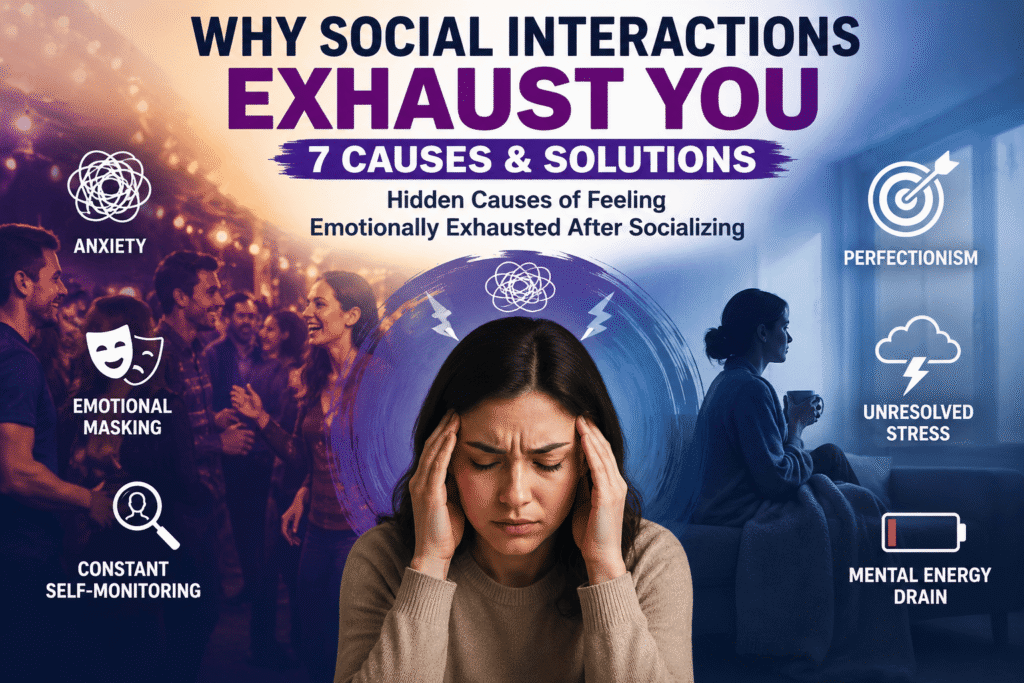
Many people assume that feeling drained after socializing means they attended too many events or talked for too long. While the amount of interaction certainly matters, the hidden psychological processes occurring during those interactions often have a much greater impact. Factors such as anxiety, perfectionism, emotional masking, unresolved stress, and constant self-monitoring quietly consume mental resources without attracting much attention. These invisible demands explain why two conversations of equal length can produce completely different levels of fatigue.
One of the biggest hidden contributors is people pleasing. Individuals who habitually prioritize others’ comfort over their own frequently spend conversations monitoring everyone else’s emotions, trying to avoid conflict, saying “yes” when they mean “no,” and suppressing their genuine opinions. Although these behaviors may appear polite, they require continuous emotional regulation and self-control. Over time, this constant emotional labor contributes to emotionally exhausted after socializing, even when interactions appear perfectly pleasant on the surface.
Another overlooked factor is decision fatigue. Every social interaction involves hundreds of small decisions: when to speak, how much to share, how to respond, whether someone is joking, whether to change the topic, and how to interpret another person’s reactions. Combined with work responsibilities and everyday life decisions, these tiny mental choices gradually deplete cognitive resources. Add chronic stress, insufficient sleep, or emotional sensitivity, and the likelihood of experiencing social anxiety exhaustion, empath fatigue, or ongoing social exhaustion increases considerably. Understanding these hidden mechanisms helps shift the focus from blaming personality to addressing the underlying mental processes that truly consume emotional energy.
Social Anxiety Exhaustion
Not everyone who experiences social anxiety exhaustion has a diagnosed anxiety disorder. Many people simply feel heightened concern about being evaluated, misunderstood, or judged during conversations. Before a social event, they may rehearse what to say. During the interaction, they carefully monitor their words, facial expressions, and body language. Afterward, they replay the conversation repeatedly, searching for possible mistakes or awkward moments. This constant mental activity creates a significant cognitive burden that extends far beyond the actual interaction.
The exhausting part of social anxiety isn’t only the event itself-it’s everything surrounding it. Anticipation before meeting people can increase stress hormones, making the body feel tense and alert even before a conversation begins. During the interaction, the brain continuously scans for signs of rejection or embarrassment. Once the event ends, many individuals engage in post-event rumination, mentally reviewing every detail in an attempt to determine whether they made a good impression. This cycle can last for hours or even days, consuming emotional energy that could otherwise be used for rest or enjoyable activities.
Breaking this pattern often begins with recognizing that perfection isn’t required for meaningful relationships. Most people are far less focused on our minor mistakes than we imagine. Practicing self-compassion, challenging unrealistic expectations, gradually exposing oneself to social situations, and learning relaxation techniques can reduce the intensity of social anxiety exhaustion over time. Rather than striving to appear flawless, focusing on genuine connection allows conversations to feel less like performances and more like authentic human experiences.
Social Exhaustion Isn’t a Weakness-It’s a Signal
Feeling emotionally exhausted after socializing doesn’t mean you’re antisocial, unfriendly, or incapable of maintaining healthy relationships. More often, it’s your mind and body communicating that they have reached their current capacity for stimulation, emotional regulation, and cognitive processing. Whether your fatigue stems from introvert burnout, empath fatigue, social anxiety exhaustion, or simple mental overload, the experience deserves attention rather than judgment.
Instead of forcing yourself to socialize beyond your limits, pay attention to the patterns. Notice which environments energize you, which relationships leave you feeling peaceful, and which situations consistently drain your emotional reserves. Small changes-such as scheduling downtime after busy events, setting healthy boundaries, getting adequate sleep, practicing mindfulness, and limiting unnecessary emotional labor-can dramatically improve your overall well-being. These habits strengthen emotional energy protection, allowing you to engage more fully when it truly matters.
Remember that your social battery is a resource, not an unlimited supply. Just as physical exercise requires recovery for muscles to grow stronger, meaningful social interaction requires periods of rest for the mind and nervous system to recover. Respecting those recovery periods isn’t selfish-it’s an essential part of living a balanced, emotionally healthy life.
Conclusion
Social interactions are one of the most rewarding parts of being human, but they also require significant mental and emotional effort. Every conversation asks your brain to interpret language, read nonverbal cues, regulate emotions, make decisions, and respond appropriately-all within seconds. For individuals with emotional sensitivity, introvert burnout, empath fatigue, or social anxiety exhaustion, these demands become even greater, making it perfectly normal to feel drained afterward.
Understanding the psychology and neuroscience behind social exhaustion helps replace self-criticism with self-awareness. Rather than asking why you’re “too sensitive” or why you “can’t keep up,” consider how your unique nervous system processes social experiences. Building healthier boundaries, prioritizing recovery, and protecting your emotional energy are not signs of weakness-they’re practical strategies that allow you to maintain meaningful relationships without sacrificing your own well-being.
When you learn to listen to your social battery instead of ignoring it, you’ll find a healthier balance between connection and solitude. That balance doesn’t just reduce exhaustion-it helps you show up as your most authentic, compassionate, and emotionally resilient self.
Frequently Asked Questions (FAQs)
1. Why do I feel tired after social interactions even when I enjoy them?
Enjoyable conversations still require your brain to process emotions, language, facial expressions, and social cues. This mental effort can lead to social exhaustion, even if you had a wonderful time.
2. Is social exhaustion only experienced by introverts?
No. While introvert burnout is common, extroverts can also experience social exhaustion, especially after emotionally demanding conversations, stressful environments, or long periods of continuous interaction.
3. What is empath fatigue?
Empath fatigue occurs when highly empathetic individuals absorb or process other people’s emotions so intensely that they become mentally and emotionally drained after socializing.
4. How can I protect my emotional energy?
Practice emotional energy protection by setting healthy boundaries, taking breaks after social events, getting enough sleep, limiting people-pleasing behaviors, practicing mindfulness, and making time for activities that help you recharge.
5. When should I seek professional help for social exhaustion?
If social exhaustion, anxiety, or emotional fatigue begins interfering with work, relationships, daily responsibilities, or your overall quality of life for an extended period, it’s a good idea to speak with a licensed mental health professional. They can help identify underlying causes and recommend appropriate coping strategies.